


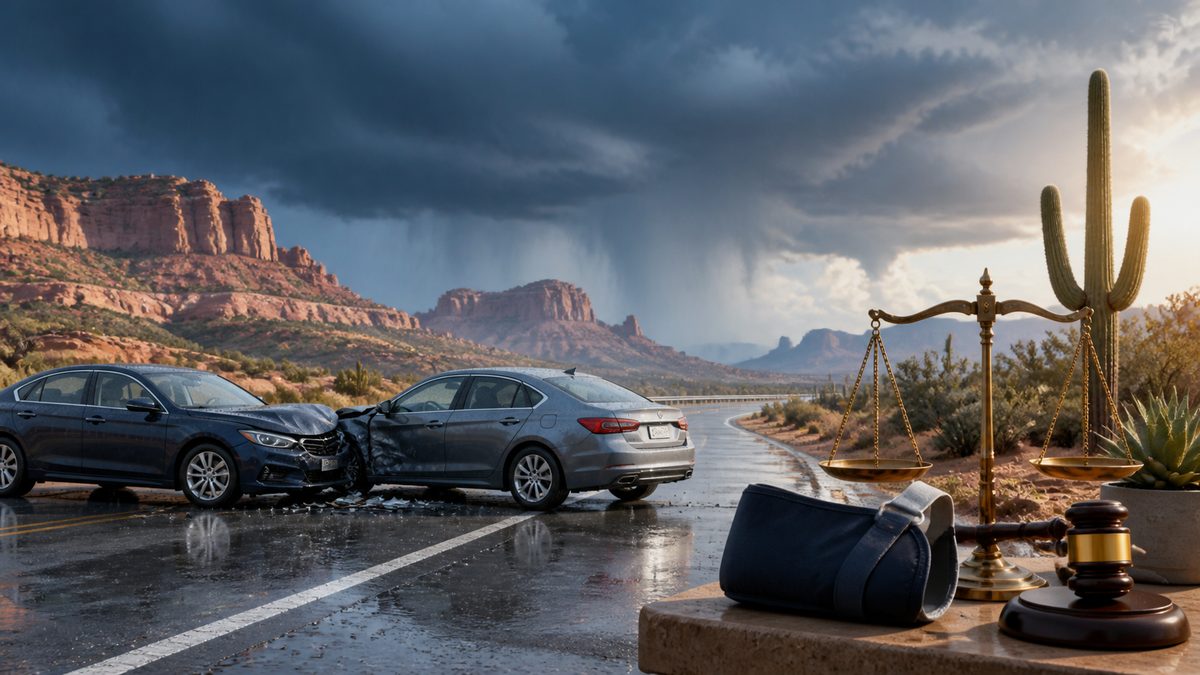
Arizona Monsoon Car Accident Liability: Dust Storms, Haboobs, and Who Is at Fault in 2026
When a haboob rolls across the Valley and visibility drops to zero in seconds, crashes happen fast, but “the storm caused it” is rarely the full legal story. Arizona monsoon car accident liability almost always comes down to driver behavior before and during the storm, not the weather itself.
TL;DR
- Bad weather does not erase driver fault in Arizona.
- Ignoring “Pull Aside Stay Alive” warnings can be treated as negligence.
- Arizona uses pure comparative fault, so you can recover even if you were partly at fault (A.R.S. § 12-2505).
- The statute of limitations for most car accident claims is two years (A.R.S. § 12-542).
- Multiple parties, including other drivers, employers, and government agencies, can share liability.
- Elmm Law Group handles monsoon crash cases throughout Arizona at no upfront cost.
Why Arizona Monsoon Car Accident Liability Is More Complex Than You Think
Arizona’s monsoon season runs roughly June through September. During that window, massive dust storms called haboobs can reduce visibility from a mile to nothing in under a minute. The Arizona Governor’s Office of Highway Safety consistently tracks weather-related crashes as a significant contributor to serious injuries and fatalities on state roads each year.
The legal complexity comes from a simple fact: weather is not a person and cannot be sued. Liability attaches to the human decisions made before, during, and after the storm. When another driver plows into your stopped vehicle because they refused to pull over, or when a commercial truck driver keeps rolling at highway speed through a wall of dust, those are negligence decisions, not acts of God.
The “Pull Aside Stay Alive” Rule and Arizona Monsoon Car Accident Liability
Arizona’s “Pull Aside Stay Alive” campaign is more than a slogan. Drivers are legally required to keep their headlights on and to reduce speed to conditions under Arizona traffic law. The campaign specifically instructs motorists to pull completely off the roadway, turn off all lights, and take their foot off the brake when visibility falls to near zero. That last point matters: a driver who stops on the shoulder with brake lights on can attract other vehicles into a deadly rear-end chain collision.
If another driver failed to follow these guidelines and hit you during a haboob, their deviation from the standard of care is strong evidence of negligence. An attorney at Elmm Law Group can document whether that driver violated traffic statutes, ignored posted warnings, or drove at an unsafe speed for conditions.
Who Can Be Held Liable in an Arizona Monsoon Car Accident
Liability in a monsoon or dust-storm crash is rarely limited to one party. Depending on the facts, the following people or entities may share responsibility.
Other Drivers
The most common defendant is a driver who kept moving through a dust storm at unsafe speed, failed to signal, drove without lights, or rear-ended a properly stopped vehicle. Speeding in reduced visibility is textbook negligence.
Trucking Companies and Commercial Operators
Commercial drivers are held to a higher standard of care. A trucking company that pressures drivers to meet delivery deadlines regardless of weather conditions can share liability for a monsoon crash. Federal hours-of-service fatigue rules may also be relevant if the driver was already impaired before the storm hit.
Government Entities
In limited cases, a city or county may share fault if a known drainage problem flooded a road without warning, or if traffic signals or variable message signs failed to alert drivers to a storm in time. Claims against government entities carry shorter notice deadlines, sometimes as little as 180 days, so acting quickly is critical.
Your Own Comparative Fault
Arizona follows a pure comparative fault system under A.R.S. § 12-2505. That means even if you were 30 percent at fault for, say, stopping too close to a travel lane, you can still recover 70 percent of your damages. The insurance company will try to inflate your percentage of fault to reduce what they owe. Having an attorney negotiate on your behalf levels that playing field.
Proving Arizona Monsoon Car Accident Liability: What Evidence Matters
Dust storms are over in minutes and leave little physical trace. That makes evidence collection urgent. The following types of evidence are most valuable in monsoon crash cases.
- Weather data and storm-tracking records: National Weather Service alerts, radar timestamps, and local news archives can establish exactly when and where the haboob hit.
- Traffic camera and dashcam footage: Arizona DOT and local municipalities operate cameras on major corridors. Dashcam video from your vehicle or nearby cars can show what conditions looked like at the moment of impact.
- Police crash report: Officers note visibility conditions, posted warnings, and whether drivers complied with storm advisories.
- Cell phone records: If the at-fault driver was texting or on a call during the storm, that adds a separate layer of negligence.
- Witness statements: Bystanders who pulled over safely often see exactly what the at-fault driver did wrong.
The ADOT Arizona Motor Vehicle Crash Facts report provides statewide data that can help contextualize the danger of weather-related driving on specific road types, which is useful background for expert witnesses.
The Statute of Limitations for Arizona Monsoon Car Accident Liability Claims
Under A.R.S. § 12-542, you generally have two years from the date of the crash to file a personal injury lawsuit in Arizona. Missing that deadline almost always means losing your right to compensation entirely. Two years sounds like a long time, but evidence disappears quickly after a monsoon crash. Cameras overwrite footage, witnesses move, and storm data archives get purged. The sooner you speak with an attorney, the stronger your case.
How Elmm Law Group Can Help After a Monsoon Crash
Gordana Mikalacki and the team at Elmm Law Group have handled weather-related crash claims across Arizona, from Phoenix freeways to rural stretches of I-10 where haboobs strike without warning. The firm works on a contingency-fee basis, meaning you pay nothing unless compensation is recovered. From gathering storm data to negotiating with commercial insurers, Elmm Law Group handles the legal heavy lifting while you focus on healing.
Frequently Asked Questions
Can I still recover compensation if the crash happened during a haboob and I was partly at fault?
Yes. Arizona’s pure comparative fault rule under A.R.S. § 12-2505 allows you to recover a portion of your damages equal to the other party’s share of fault, even if you bear some responsibility. For example, if you are found 20 percent at fault and your damages total $100,000, you can still recover $80,000. An attorney can help push back against inflated fault percentages assigned by the insurance company.
What if the other driver says the storm was an “act of God” and they are not liable?
The “act of God” defense rarely succeeds in Arizona monsoon car accident liability cases. Arizona monsoon season is predictable, well-publicized, and accompanied by official warnings. Courts generally find that a driver who chose to keep moving through near-zero visibility assumed the risk of those conditions. The storm may have created the hazard, but the driver’s decision to ignore it is what the law focuses on.
How long do I have to file a claim after a monsoon car accident in Arizona?
For most personal injury claims, you have two years from the date of the crash under A.R.S. § 12-542. If a government entity is involved, a notice of claim must typically be filed within 180 days. Do not wait to speak with an attorney, because critical evidence like traffic camera footage and weather records can disappear within days or weeks of the crash.
Does my own insurance cover me if the at-fault driver had no insurance?
Arizona requires drivers to carry minimum liability insurance under A.R.S. § 28-4009, but uninsured motorists are still common. If you carry uninsured or underinsured motorist (UM/UIM) coverage, your own policy may step in to cover your losses. An attorney can review your policy and identify every available source of compensation.
What should I do immediately after a monsoon car accident in Arizona?
First, stay safe. If your vehicle is drivable, move it completely off the road, turn off all lights, and keep your foot off the brake. Call 911, document the scene with photos as soon as it is safe to do so, collect contact and insurance information from other drivers, and seek medical attention even if you feel fine. Then contact an attorney at Elmm Law Group before speaking with any insurance adjuster.